
Criminal Court Cases in Saratoga County
Saratoga County criminal cases can begin in more than one court. County Court at 30 McMaster Street, Building 3, in Ballston Spa conducts felony trials. Saratoga Springs City Court, Mechanicville City Court, and the county's Town and Village Justice Courts hear misdemeanors, violations, traffic matters, arraignments, and preliminary felony proceedings. After a grand-jury indictment or a superior court information, a felony can move from the local court to County Court. That move explains why one court search may show only part of the path.
The clerk of the court that heard a stage of the case keeps that court's docket and documents. The Saratoga Supreme and County Court Clerk's Office is open from 9:00 a.m. to 5:00 p.m. and can be reached at (518) 451-8840. The County Clerk also describes itself as the repository for Supreme and County Court records. For a local matter, use the Unified Court System court locator to find the City, Town, or Village Court instead of sending the request to the Sheriff's Office.
Saratoga County Courts Route Charges
The charge level and the current stage determine where a Saratoga County court file lives. A misdemeanor may stay in a local court from arraignment through disposition. A felony accusation may start there but finish in County Court. Supreme Court shares the courthouse complex, though County Court is the county's felony trial court.
| Court | Main criminal role | Contact route |
|---|---|---|
| Saratoga County Court | Felony trials and related statutory work | 30 McMaster St., Building 3; (518) 451-8840 |
| Saratoga Springs City Court | City misdemeanors, violations, arraignments, traffic, early felony work | City Hall, 474 Broadway; verify the clerk number on the official court page |
| Mechanicville City Court | Local misdemeanors, violations, arraignments, traffic, early felony work | City Hall, 36 North Main St.; verify through the official UCS listing |
| Town and Village Courts | Local offenses and first-stage felony matters | Use the Unified Court System court locator and call the issuing court |
Record the exact court named in any search result. That name points to the clerk who can retrieve the source file and issue a certificate of disposition.
Saratoga County Case Record Searches
WebCriminal is the free statewide starting point for pending and disposed public criminal cases. It may show the court, docket number, top charge, status, appearance information, and disposition. It does not promise a downloadable case file or a certified result. Exact identifiers matter because names can be shared and spelling can vary.
- Open WebCriminal and choose the defendant or case-number search path.
- Enter the exact last and first names, then add a middle name or date of birth when the form permits.
- Limit the county to Saratoga, or use the exact case number if it is known.
- Record the court, docket number, status, next appearance, and stated disposition. Repeat the search for a known alternate spelling when needed.
- Contact the named clerk for documents, copy terms, or a certificate of disposition. Ask about fees and payment before ordering because local criminal copy prices were not published in the reviewed sources.
| Field label | Type | Required | Notes |
|---|---|---|---|
| Defendant Last Name | Text | Yes for name search | Try supported spelling variations separately. |
| Defendant First Name | Text | Portal controlled | Use the legal name rather than a nickname. |
| Defendant Middle Name | Text | No | Helps narrow common names. |
| Date of Birth | Date or text | Optional or portal controlled | Use MM/DD/YYYY where accepted. |
| County | Dropdown | No | Select Saratoga to narrow the result set. |
| Case Number | Text or tab | Alternate route | Use the exact docket when known. |
Save the court and docket number rather than relying on the display name alone. Then ask the clerk whether the public file is electronic, archived, or available at the counter.
SearchIQS Limits Saratoga County Cases
The Saratoga County Clerk court-record page links to SearchIQS and tells users to create an account or select a subscription plan. That link can be useful for indexed county material. It should not be treated as proof that every criminal docket or document is online. The reviewed county page does not guarantee full criminal coverage, and sealed records remain unavailable.
Start a current criminal search in WebCriminal. Then call the clerk named by the result. For an old record, ask whether the volume has been digitized or must be retrieved from an archive. This two-step check prevents a gated index or a blank result from being mistaken for proof that no Saratoga County case exists.
Note: SearchIQS access and a WebCriminal result are indexes, not substitutes for a clerk-certified disposition.
What a Criminal Case File Contains
A Saratoga County criminal file follows what the prosecutor filed and what the court did. That makes it different from a police arrest report. The docket can show an accusatory instrument, appearances, motions, a plea or trial, disposition, and sentence. Charge wording may change as the case moves, so compare each entry with its date and document type.
| Case number and court | Identifies the docket and the clerk who holds the file. |
|---|---|
| Charging document | Shows the complaint, information, indictment, or superior court information supporting the prosecution. |
| Charge details | Lists the top charge, description, Penal Law or VTL section, and felony, misdemeanor, or violation class. |
| Docket entries | Tracks filed events, motions, orders, and appearances in date order. |
| Hearing details | Can show the date, time, part, and purpose of an appearance. |
| Disposition and sentence | States the reported outcome and sentence summary when public and entered. |
| Access limits | Victim identifiers, private numbers, sealed content, and some warrant details are withheld. |
Protected identifiers and sealed content do not become public merely because the docket itself can be found.
Saratoga County Case Outcome Certificates
A certificate of disposition is the clerk's certified statement of a criminal case outcome. It is the stronger choice when a screenshot shows a vague code, an old entry lacks detail, or a person needs to correct their own state record. Ask the originating court, not the Sheriff or jail, because the court owns the disposition.
- Disposition
- The result of a charge or case.
- Dismissal
- The charge ended without a conviction.
- Acquittal
- A not-guilty verdict after trial.
- Conviction
- A judgment based on a guilty plea or verdict.
- Certificate of disposition
- A clerk-certified statement of the outcome.
When a DCJS Personal Record Review shows a missing or mismatched outcome, compare the docket number, arrest date and agency, and exact name and date of birth. Send DCJS the certified disposition through its challenge route. A sealed cycle may still appear on the subject's own unsuppressed response even when it is absent from public court search.
Criminal Case Stages in Saratoga County
The public court trail begins after charges reach a court. A local criminal court handles arraignment and early proceedings. A grand-jury indictment or permitted waiver leading to a superior court information can place a felony in Saratoga County Court. Pleas, motions, trial events, a final disposition, and sentencing are then entered on the docket as they occur.
Case flow: Charges Filed › Arraignment › Pretrial › Plea or Trial › Disposition › Sentencing
The arresting charge is not frozen through this flow. A prosecutor may reduce, replace, dismiss, or consolidate charges. For the police account, request the incident or arrest report from the creating agency. For filed charges and the final result, use the court file. The broader Saratoga County arrest search explains that agency split.
Saratoga County Court Archives Since 1791
The Saratoga County Clerk reports court records dating to 1791 and more than 20 million digitized county documents across categories. That depth can serve genealogy and local-history work. It does not mean every old criminal volume is indexed online, and it does not open sealed files.
For an older case, give the clerk the fullest known name, approximate year, court, and docket reference. Ask whether the file is digital, on site, or archived. Confirm the correct counter before travel because County Court, the County Clerk complex, and the Sheriff's Public Safety Facility do not share one address.
The records corridor in Ballston Spa is split among several buildings. Saratoga County Court is at 30 McMaster Street, while the County Clerk and general county offices use the 40 McMaster Street complex. The District Attorney is at 25 West High Street. A criminal archive request should begin with the court or County Clerk rather than the prosecutor. Visitors should expect courthouse security screening and bring photo identification. The official court material did not establish a firm cellphone or locker rule, so call the clerk before arriving with recording equipment. Parking and transit details were also not confirmed in the reviewed official sources.
OCA Saratoga County Criminal Name Search
The New York Office of Court Administration Criminal History Record Search offers another statewide court-record path. Its application uses a full name, date of birth, and aliases or additional names when relevant. The requester supplies contact and payment data. The fee is $65 per search, even when no match is returned.
The official OCA page shows how this separate product is requested.
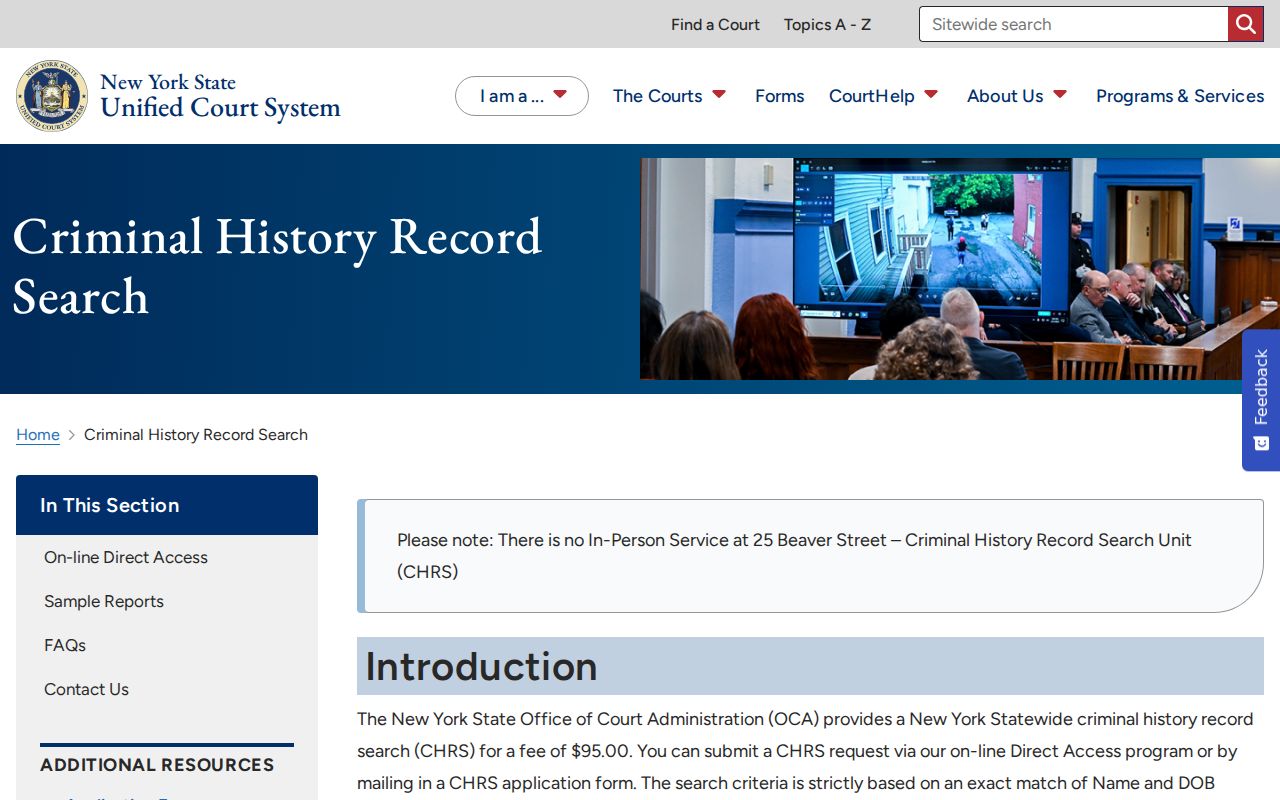
The image reinforces the key distinction: OCA searches public court records by name and date of birth, while DCJS Personal Record Review is a fingerprint-matched record available to the subject or the subject's attorney.
Access Rules for Case Records
Public access in Saratoga County is shaped by court rules and New York sealing law. Judiciary Law §212 and Unified Court rules govern court-record administration. Court files are requested through the judiciary and the clerk, not through ordinary executive-agency FOIL. Public Officers Law Article 6 applies to agency records, but it does not turn DCJS rap sheets into public files.
If a known case is absent, verify the court, spelling, date of birth, and docket. Ask the clerk whether it is sealed, archived, or held by another court. New York's phased Clean Slate process under CPL 160.57 can also remove eligible convictions from ordinary public view as court sealing orders are implemented. A blank public search must not be read as a full statement of a person's history.
A written denial or access limit should identify the basis for withholding. Where only part of a record is restricted, ask whether a public copy can be produced with protected details removed. Grand-jury minutes, sealed matters, youthful-offender records, and sensitive victim data are not opened merely because another docket entry is public. When identity or outcome is the real issue, a narrow request for the public docket and certificate of disposition is often more useful than asking for every paper in the file.